

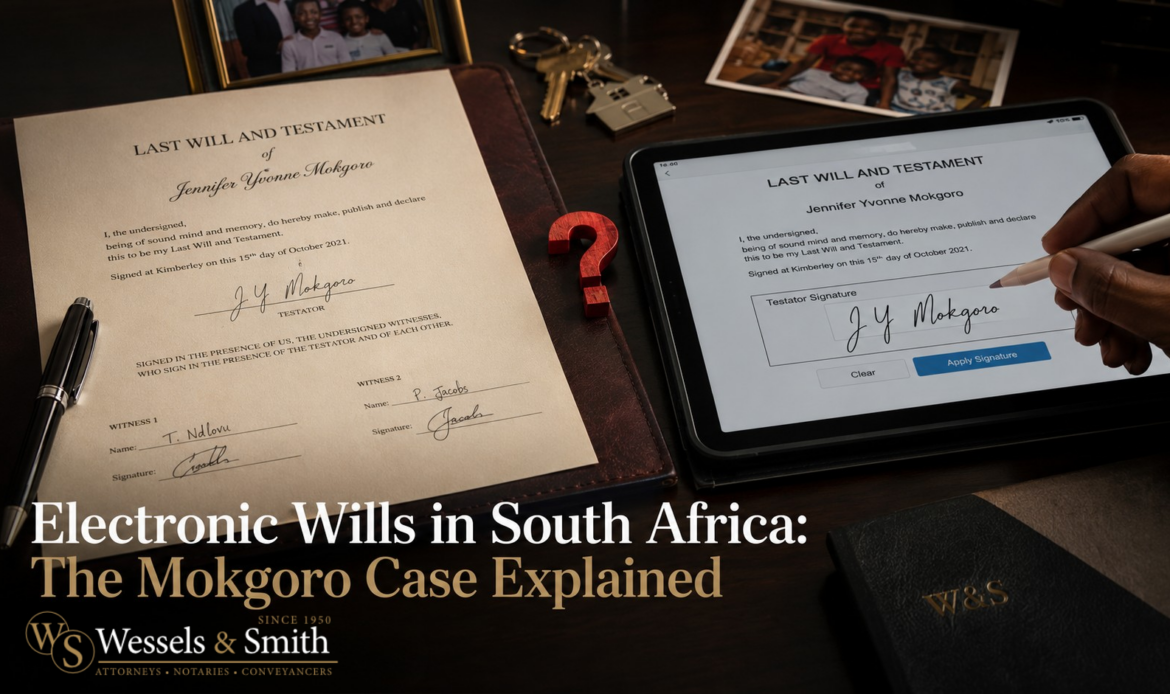
South Africans increasingly conduct some of their most important affairs electronically. We apply for finance online, sign commercial agreements digitally, receive bank and tax documents electronically and store important records in the cloud. Against that background, it is understandable to ask why a last will and testament should be any different.
The answer is that wills occupy a particular place in South African law. The execution of a will is governed primarily by the Wills Act 7 of 1953 (“the Wills Act”), which prescribes formalities intended to create certainty about the document that represents a deceased person’s final wishes. Electronic transactions are generally facilitated by the Electronic Communications and Transactions Act 25 of 2002 (“ECTA”), but ECTA specifically treats wills differently from ordinary electronic transactions.
That distinction became especially important in Mokgoro and Others v Master of the High Court, Kimberley and Others (09/2025) [2025] ZANCHC 60 (1 August 2025) (“Mokgoro”). The Northern Cape High Court directed the Master of the High Court to accept a 2021 electronically executed document as the will of the late former Constitutional Court Justice Jennifer Yvonne Mokgoro.
At first glance, that sounds like a judgment declaring electronic wills valid in South Africa. It did not.
The real importance of Mokgoro lies in the difference between executing a will in compliance with the ordinary statutory formalities and asking a court, after the testator’s death, to rescue a document that did not comply with those formalities.
The starting point: what the Wills Act requires
Section 2(1) of the Wills Act sets out the formal requirements for the execution of a will. In broad terms, the testator must sign the will in the required manner, the signature must be made or acknowledged in the presence of two or more competent witnesses who are present at the same time, and those witnesses must attest and sign the will in the presence of the testator and each other. Additional requirements apply where a will consists of more than one page or where another person signs on behalf of the testator.
The Department of Justice and Constitutional Development accordingly continues to advise members of the public to ensure that a will is properly signed and witnessed and that the original signed will is kept in a safe place. The original is particularly important when a deceased estate is later reported to the Master.
These formalities are not simply bureaucratic obstacles. A will generally only becomes operative once its maker has died. At that stage, the person whose intentions matter most is no longer available to explain whether a document was final, whether a signature was genuine, whether a draft had been approved, whether pressure was applied or whether a later version replaced an earlier one.
Formal execution therefore helps answer a vital question after death: is this genuinely the document by which the deceased intended to dispose of his or her estate?
Why ECTA does not simply make an electronic signature sufficient
ECTA transformed South African law by recognising electronic communications and facilitating electronic transactions. It would therefore be tempting to reason that if an advanced or ordinary electronic signature can have legal effect in other contexts, the same principle must automatically apply to a will.
The legislation does not work that way.
Section 4(4) of ECTA provides that the Act must not be construed as giving validity to transactions mentioned in Schedule 2. Schedule 2 specifically includes the execution, retention and presentation of a will or codicil as defined in the Wills Act. Certain of ECTA’s general provisions relating to the legal recognition of electronic documents are also excluded in relation to the Wills Act through Schedule 1.
In practical terms, this means that a person should not assume that using DocuSign, inserting a scanned signature, clicking an electronic-signature button or signing a PDF on a tablet makes the document an ordinarily valid will merely because electronic signatures are accepted for many other transactions.
That is precisely why Mokgoro is so important: the successful argument was not that ECTA had made the 2021 document formally valid. The application was brought under a different provision altogether—section 2(3) of the Wills Act.
What happened in the Mokgoro matter?
Justice Jennifer Yvonne Mokgoro died on 9 May 2024. During the administration of her estate, two documents became relevant.
There was a 2014 will, of which an original was available and under which an executor was initially appointed. There was also a later document dating from 2021. The later document was important because it reflected a later testamentary arrangement, but it had not been executed in compliance with the conventional formalities ordinarily required by the Wills Act. The 2021 document involved electronic signatures.
The matter eventually came before the Northern Cape Division of the High Court in Kimberley. The applicants did not ask the Court simply to declare that electronic signatures satisfy the ordinary requirements for wills. Instead, they relied on section 2(3) of the Wills Act.
Section 2(3) is an important remedial provision. In essence, where a deceased person drafted or executed a document that does not comply with all the formalities for a valid will, a court may order the Master to accept it as a will if the statutory requirements are established and the court is satisfied that the deceased intended that document to be his or her will.
This provision exists to prevent a genuine testamentary intention from necessarily being defeated by a failure to comply with formal requirements. But it is an exceptional remedial mechanism, not an alternative method people should deliberately use to make their wills.
In Mokgoro, the evidence surrounding the 2021 document was therefore critical. The Court considered the deceased’s direct involvement in the document, the instructions communicated in relation to it, the manner in which it was executed, the electronic communications and the evidence relating to the witnesses. The Court concluded that the jurisdictional requirements of section 2(3) had been established and that the 2021 document reflected Justice Mokgoro’s testamentary intention. It accordingly ordered the Master to accept that document as her will for purposes of the administration of her estate.
The distinction cannot be overstated: the Court accepted the particular document because the requirements for judicial condonation under section 2(3) were proved. It did not hold that electronically signing a will is now an ordinary, compliant method of executing wills in South Africa.
The 2026 application for leave to appeal
The litigation did not end with the August 2025 judgment.
An application for leave to appeal was subsequently considered in Mmelesi v Mokgoro N.O and Others (09/2025) [2026] ZANCHC 8 (30 January 2026). On 30 January 2026, the Northern Cape High Court dismissed the application for leave to appeal.
That development reinforced the practical significance of the original decision, but it still does not convert the judgment into a general rule authorising South Africans to execute wills electronically without regard to the formalities in the Wills Act.
The safer reading is much narrower: section 2(3) can, in an appropriate case and on sufficient evidence, prevent a genuine testamentary intention from failing solely because the document did not satisfy all of the ordinary execution formalities.
That is very different from advising someone to create the defect in the first place.
A court rescue is not the same thing as a properly executed will
This distinction has significant consequences for estate planning.
A properly executed will can ordinarily be produced to the Master during the deceased-estate process and dealt with as a will. A defective electronic document may instead place the family, executor or intended beneficiaries in the position of having to approach the High Court.
That may involve affidavits, documentary evidence, witnesses, attorneys, advocates, delay, costs and the possibility of opposition from a person who benefits under an earlier will or under intestate succession.
There may also be factual disputes. Was the electronic document truly final? Was the deceased still reviewing it? Who created the electronic signature? Were there later versions? Did the deceased approve the final wording? Was the file changed after it was signed? Was the document intended as a will or only as instructions to an attorney to prepare one?
The stronger the evidence, the stronger a section 2(3) application may be. But the entire point of good estate planning is to reduce those questions before they arise.
Mokgoro therefore demonstrates both the usefulness of section 2(3) and the cost of needing it.
What about a PDF, WhatsApp message or email containing your wishes?
Digital records can be valuable evidence, but they should not be confused with ordinary compliance.
A scanned copy of a properly signed will can help a family identify what the deceased had planned and may assist in locating the institution or attorney holding the original. That does not make a scan an ideal substitute for preserving the properly executed original.
Likewise, an email, WhatsApp message, electronic note or unsigned draft may contain important evidence about a deceased person’s wishes. Depending on the circumstances, litigation under section 2(3) may be considered. But the mere existence of a message saying “this is what I want to happen when I die” does not automatically turn that message into an accepted will.
The court would still have to determine whether the statutory requirements are satisfied and, critically, whether the deceased intended the particular document itself—not merely the ideas contained in it—to operate as his or her will.
That distinction becomes especially important where several digital files exist with names such as “Will Final”, “Will Final 2” and “Will FINAL New”, or where messages show that the deceased was still considering changes.
The practical lesson for South African families
The safest estate-planning strategy remains straightforward: have the will properly drafted, execute it in compliance with the Wills Act and preserve the original securely.
A review is particularly sensible after major life events such as marriage, divorce, the birth or adoption of a child, purchasing or selling property, starting or disposing of a business, establishing a trust, the death of a beneficiary, a significant change in financial circumstances or a change in the person you would want to act as executor.
It is also important to remember that changing an electronic copy on a computer does not necessarily change the legally operative will. If an amendment, replacement will or codicil is required, the applicable formalities must be addressed.
Digital records can still form part of sensible estate planning. A reference copy may be stored electronically, and a trusted family member can be told where the original is held. Technology should make the valid original easier to locate—not create uncertainty about which version governs the estate.
Conclusion: the Mokgoro case is a warning as much as a breakthrough
Mokgoro is an important South African judgment because it demonstrates the ability of section 2(3) of the Wills Act to protect genuine testamentary intention in an increasingly digital world. The Court was prepared, on the particular evidence before it, to direct the Master to accept an electronically executed document despite its failure to comply with the ordinary formalities.
But the judgment should not be reduced to the headline “electronic wills are now legal”.
The statutory framework remains important. ECTA does not itself give validity to the electronic execution, retention or presentation of a will, and the ordinary formalities under the Wills Act continue to matter. A section 2(3) application is a remedial process available after something has already gone wrong; it is not a substitute for sound estate planning.
The strongest will is therefore not the one your family might eventually succeed in proving in the High Court. It is the one that clearly records your intentions, complies with the applicable formalities and can be found when it is needed.
Wessels & Smith Inc assists clients with the drafting and updating of wills, estate planning, testamentary arrangements and the administration of deceased estates. Obtaining advice while your intentions can still be clearly recorded may prevent uncertainty, delay and unnecessary litigation later.
Disclaimer: This article provides general legal information and does not constitute legal advice. The validity and interpretation of wills depend on the facts and documents in each matter. Professional legal advice should be obtained for individual circumstances. Contact Wessels & Smith Inc with your legal matter.